Phone: +86-755-2357-1819 Mobile: +86-185-7640-5228 Email: sales@ominipcba.com whatsapp: +8618576405228

The Building Blocks of Innovation: A Deep Dive into Essential PCB Components
If you were to crack open an electronic device from the late 19th century, you wouldn’t find a sleek green board. You would find a chaotic mess of Bakelite, Masonite, and thick wooden planks supporting bulky vacuum tubes. Fast forward to 2026, and the "brains" of our world have shrunk to a microscopic scale. The transition from massive through-hole components to almost invisible Surface Mount Devices (SMD) has redefined what is possible in hardware engineering.
PCB TECHNOLOGYPCB MANUFACTURINGPCB ASSEMBLY
OminiPCBA
3/9/20263 min read
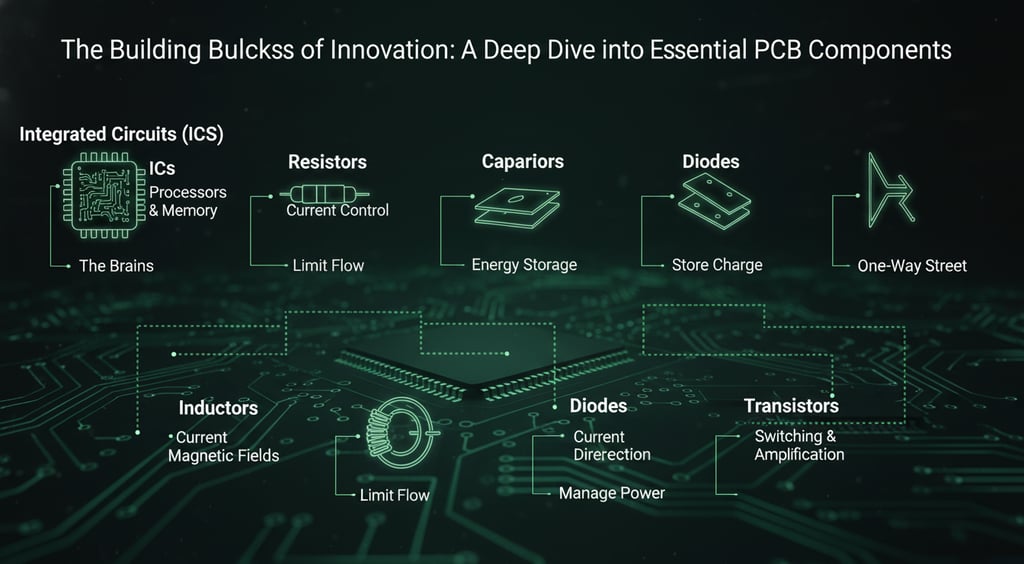
At OminiPCBA, we view a Bill of Materials (BOM) as more than just a component list—it is the blueprint for hardware reliability. Every part, from a precision resistor to a high-performance SoC, is critical to the longevity and performance of your circuit. To ensure your next design is optimized for the rigors of modern manufacturing, here is a breakdown of the core components driving today’s PCB assembly.
1. The Passive Foundation: Signal Integrity and Stability
Passive components are the silent workhorses of any PCB. They require no external power but are solely responsible for system safety, voltage stability, and noise suppression.
Resistors (Current Control): Beyond simple current limiting, resistors are essential for voltage division and establishing logic levels (pull-up/pull-down). In high-precision PCBA, selecting the correct tolerance and power rating is vital to preventing signal drift and component overheating.
Capacitors (Energy Reservoirs): In high-speed digital designs, capacitors are used for decoupling and bypassing. By placing them strategically near IC power pins, they act as local reservoirs to smooth voltage fluctuations, preventing data corruption and unexpected system resets.
Inductors (Magnetic Filtering): Inductors utilize magnetic fields to filter high-frequency noise and facilitate power conversion. For RF and microwave PCBs, they are indispensable for impedance matching, ensuring maximum power transfer and protecting transmitters from signal reflection.
2. Active Components: Precision Logic and Switching
Active components serve as the "engines" of the board, requiring power to manipulate signals, amplify voltages, and manage high-power loads.
Diodes (Directional Protection): These semiconductors ensure current flows in a single direction, making them critical for AC-to-DC rectification and reverse-polarity protection.
LEDs: High-efficiency light sources for indicators and high-power arrays.
Zener Diodes: Essential for voltage regulation and protecting sensitive circuitry against voltage spikes.
Transistors (The Switches of Modern Electronics): While BJTs remain relevant, MOSFETs dominate modern PCBA. Their ability to handle high-speed switching with minimal heat dissipation makes them the preferred choice for power management and digital logic circuits.
3. Integrated Circuits (ICs): The Intelligence Layer
ICs integrate millions of discrete functions into a single silicon footprint, providing the computational "brains" of the device.
MCU vs. MPU: Microcontrollers (MCUs) are self-contained "computers on a chip," ideal for embedded control in medical devices or IoT sensors. Microprocessors (MPUs) offer raw computing power for data-heavy applications like AI hardware and laptops, requiring external RAM and storage.
Operational Amplifiers (Op-Amps): The backbone of analog signal processing, Op-Amps amplify minute sensor signals into readable data for the MCU, ensuring accuracy in complex environments.
4. Connectivity, Timing, and Protection
Reliable hardware depends on its ability to interface with the world and maintain internal synchronization.
Oscillators & Crystals: Every digital system requires a precise "heartbeat." High-quality crystal oscillators provide the clock signals necessary for synchronous data movement; timing jitter here can lead to total system failure.
Sensors: These components translate environmental data—heat, motion, or pressure—into electrical signals, acting as the eyes and ears of your hardware.
Connectors: Often the most vulnerable mechanical point, selecting the right connector requires balancing physical durability with signal integrity and insertion loss.
Fuses & Relays: These provide the primary defense. Fuses act as sacrificial protection against short circuits, while relays allow low-power signals to safely control high-voltage lines.
The OminiPCBA Advantage: Engineering for Manufacturability
In electronic manufacturing, an electrically perfect schematic is only half the battle. Real-world success requires a deep focus on DFM (Design for Manufacturing) and DFA (Design for Assembly).
A component may meet your specs, but if it faces a 52-week lead time or is nearing End of Life (EOL), your project is at risk. At OminiPCBA, our engineering team provides a rigorous Free DFM Check as part of our service. We analyze your footprints, optimize passive packages (such as 0201 or 0402) for our high-speed SMT lines, and mitigate "tombstoning" risks during the reflow process.
Reliability is never accidental—it is engineered. From dielectric selection to thermal via optimization for MOSFETs, OminiPCBA is your partner in building resilient, scalable hardware.
Related Articles
Contacts
Email: sales@ominipcba.com
Mobile: +86-185-7640-5228
Copyright © 2007-2026. Omini Electronics Limited. All rights reserved.
Head Office: +86-755-2357-1819
Services


Your China turnkey partner for electronics manufacturing. We bridge design to delivery by leveraging the Shenzhen electronics ecosystem for precision engineering and streamlined PCBA supply chain logistics.
Ready to Build?
Get a comprehensive quote within 24 hours.