Phone: +86-755-2357-1819 Mobile: +86-185-7640-5228 Email: sales@ominipcba.com whatsapp: +8618576405228

Mastering 224G Signal Integrity: PCB Design & Fab Realities
Overcome insertion loss and impedance hurdles in 112G/224G SerDes designs. Learn how advanced PCB assembly, material selection, and fabrication tolerances define high-speed success.
PCB TECHNOLOGYPCB MANUFACTURINGPCB ASSEMBLY
OminiPCBA
1/9/20267 min read
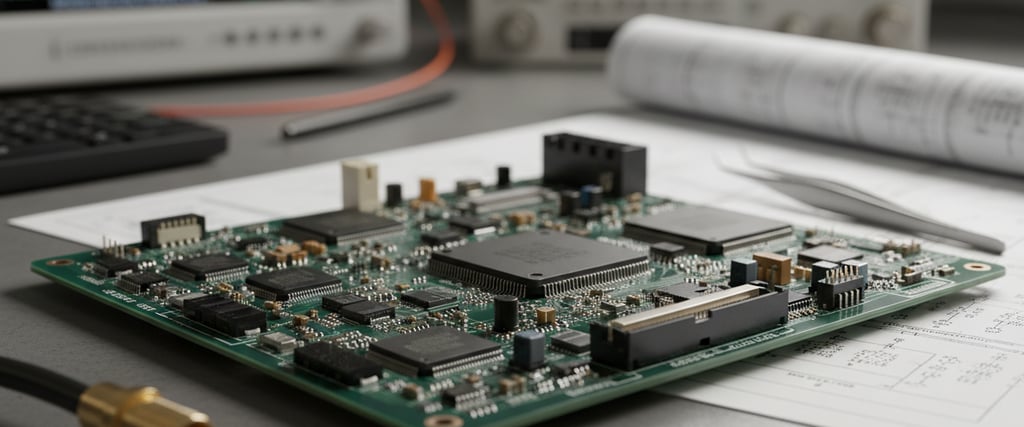

Moving up to 224 Gbps from 112 Gbps changes how circuit boards must be built. Where 112G PAM4 stretched normal production limits, 224G allows zero room for mistakes. Because signals move so fast now, the board itself stops being just a platform - instead, it acts like part of the wiring, dragging down performance even before transmission begins.
Now here's something engineers plus emergency medical services folks both face: passing a test run means nothing if the actual circuit fails. When signals hit 224G, their wave peaks squeeze down tight - so tight that tiny flaws made during production start breaking everything. Think uneven copper surfaces, misaligned fiberglass layers, coatings applied too thick - all these small slips twist the signal path until it snaps.
The Physics of Loss Without the Dielectric
Skin deep signals fight tougher battles now. Picking top-tier materials such as Megtron 8 once solved most problems. Yet even these advanced laminates fall short at extreme speeds. Because signal strength drops more due to metal paths than insulation layers. Only targeting insulation flaws ignores the growing impact of surface resistance. High-frequency currents cling tighter to conductor edges, increasing heat and weakening output. What worked before fails under new demands.
When frequencies go up, electrical flow gets squeezed near the outer edge of copper. Since most common electrodeposited copper looks like jagged peaks - designed to stick better - electrons zigzag more, facing higher opposition and signal fade. That push forces a move to smoother types, such as Hyper Very Low Profile foil. Yet switching brings new hurdles. With less texture, the grip between metal and insulating layer drops, raising risks of separation. Fixing this means unique chemical steps in production, keeping layers stuck while staying smooth.
The Glass Weave Effect
One quiet problem in fast digital connections comes from how fiberglass layers are built. Circuit boards use cloth made of glass threads soaked in sticky material. That glass slows electrical waves more than the coating around it does. When split signals travel side by side, uneven paths can form - one above thick strands, another above thin spots. These differences make timing drift apart between them. The mismatch twists clean pulses into messy ones. Noise spreads where it should not be. Signal quality drops without warning. Eyes close. Radiation leaks out more easily.
One way to reduce the issue is zig-zag routing, yet it takes up too much space on the board. Instead, some choose spread glass materials - such as 1067 or 1086 - where fibers get stretched to fill spaces. Top-tier PCBA suppliers sometimes suggest turning the design by 10 degrees compared to the weave pattern, which helps smooth out differences in Dk along the signal path.
Impedance Control and the Manufacturing Divide
A simulation might show clean lines, but real-world results depend on factory precision. Getting 92 or 100 ohms right happens not in software, yet on actual boards. After etching, copper does not keep straight edges - it slopes inward like a pyramid slice. That shape change shifts electrical behavior more than expected. Height compared to width differences defines how signals travel - this balance shapes performance.
Too much wiggle room shows up as trouble when speeds hit 112G or 224G. Most shops once tolerated ±10%, but that won’t cut it anymore. Now the bar sits at ±5%, sometimes even tighter - down to ±3%. Manufacturing lines feel every bit of that squeeze. Checking copper paths means catching their thickness right where they rise and where they flatten out, not just guessing. Machines must see those details without missing a beat.
Sometimes things go off track right where the prepreg meets the core - that spot tends to show shifts in impedance. When heat and pressure squeeze everything together, how much copper sits nearby changes how the resin moves, which tweaks the space between layers (H). Because of this ripple effect, tossing in extra bits of unused copper isn’t only about even plating anymore - it holds the spacing steady, locking in stable signal behavior across the board.
Via Structures and the Issue of Stubs
A tiny leftover bit inside a hole drilled through a circuit board starts behaving like a signal trap at 224 gigahertz. Just ten thousandths of an inch of that extra metal might carve out a sharp dip in signal strength right where the system needs clean performance.
Starting halfway through the process, removing excess via material has become common practice - yet how far the bit goes matters a lot. Stop just shy, leftover metal ruins transmission quality. Go even slightly past target, you break contact with inner circuitry. Newer board production methods stack layers step by step, reducing need for cleanup drilling altogether. Instead they build pathways inside without openings to surface, cutting unwanted extensions by design.
Still, the via’s shape creates a pocket where capacitance builds up. Because of that, engineers carve away parts of the ground layers near the via - these empty zones are called anti-pads. Finding the right anti-pad width means running repeated simulations using full 3D field tools. That way, the magnetic effect from the via’s metal wall cancels the electric storage in the gap, so overall it acts like a steady 50-ohm path for the signal.
Surface Finish Meets Nickel Barrier
Most times, what you pick for a surface comes down to how long things sit around or price tags. High-speed circuits treat that layer like part of the circuit itself. ENIG shows up everywhere across factories and labs. That coating includes nickel, which grabs onto magnetic fields. When signals race past a few billion cycles each second, that pull messes with strength and timing in ways hard to ignore.
Faster than 112G, things move away from magnetic coatings. Instead, different surface treatments start appearing more often. Not magnet-based options grow common past that speed. New kinds of finishes show up where old ones used to be. Beyond this point, the usual materials fade out slowly. What once worked now gets replaced without much fanfare
A thin organic coating keeps solder joints clean and flat - also blocks any magnetic effects. Still, time limits how long it lasts before losing function. Careful steps must follow when placing parts on boards using this method. Smooth finish comes at the cost of tighter control needs. Its lifespan shrinks compared to alternatives. Handling demands attention but delivers even surfaces. No magnetism shows up during operation. This type stays fragile until heated properly. Freshness matters more here than elsewhere. Surface quality wins while storage loses. Precision becomes necessary due to sensitivity. Oxidation risk rises without fast processing. Flatness helps machines place tiny components accurately. Protection fades faster if left unused too long. It works well only under strict conditions.
Starting with a flash of silver, immersion plating brings top-notch signal flow without blocking nickel. Yet when humidity climbs or air turns sour, that shine can darken fast. Slow creeping damage might follow where moisture lingers too long.
A thin gold finish forms without using nickel, which keeps it ready for wires to bond. Yet the process runs pricier than alternatives. Cost climbs due to rare materials involved.
The Assembly Effect Solder and Air Pockets
Once the bare board is made, signal problems can still pop up. Solder joints added during full assembly act like uneven impedance spots where signals meet their endpoints. How much solder paste goes in changes how tall or wide those connections become. That size shift tweaks the way they store electrical energy.
Air gaps stuck in solder joints can cause issues especially with fast Ball Grid Array parts. Even if the connection works fine electrically or holds during strength checks, that empty space shifts how signals move through nearby materials since air scores 1.0 on permittivity. This tiny pocket also forces electrons to travel different routes than planned. Getting rid of these bubbles means adjusting heat timing before melting begins letting gases flee earlier in the process.
Much later, trapped gunk inside tight circuit links might start acting like a conductor when humidity sneaks in. Though factories usually skip cleaning these sticky leftovers, things shift at 224G speeds. What counts as tidy enough gets redefined. A few rugged designs insist on rinsing anyway - just to stop faint leaks or shifts in how well nearby signal lanes stay insulated.
Crosstalk Control Along Vertical Axis
With more components packed together, trace-to-trace interference stays under control through spacing like 3W or 4W. Still, noise between layers now plays a bigger role. When backplanes have many layers, signals on Layer 3 might strongly interact with those on Layer 5 - especially if Layer 4, meant to shield them, contains gaps or breaks.
Close placement of ground vias near signal vias helps manage vertical current flow with less inductance. That setup acts like a shield, keeping stray fields under control. Real-world production checks - like tests done at Ominipcba - show missing return paths cause voltage shifts. These shifts add timing noise, shrinking the window for reliable data reading.
Testing Verification Closing the Loop
A single flying probe check falls short when testing a 224G path. Instead, engineers rely on Time Domain Reflectometry to sketch out how impedance shifts across every inch of the line. That visual output shows precise spots where things go off track - maybe near the BGA exit zone, perhaps at the plug's base, sometimes mid-layer shift.
Measuring S-parameters is what Vector Network Analyzers do, focusing on things like Insertion Loss (S21) along with Return Loss (S11). When real-world results show differences from simulations, it usually points to mismatches in dielectric properties - those predicted during layout against what appears after curing in the final circuit board.
The Whole Picture
Hitting 224G speed isn’t just about clever layouts, yet it goes beyond factory skill too. From lab insights to signal physics, success ties together unexpected fields. Because material behavior shapes outcomes, so does how layers come together under heat and pressure. When engineers know the limits of etching tools, results improve - just as builders gain when they grasp signal loss risks. One part depends on another, even if they seem far apart at first glance.
Gone are the days when engineers tossed designs over the fence without follow-through. When speeds climb skyward, cooperation becomes essential - stack-ups get shaped together, materials tested thoroughly, assembly adjusted carefully to keep signals clean. Without tight coordination across teams, copper and glass hit their limits fast, unable to handle what tomorrow’s data loads will require.
Related Articles
Contacts
Email: sales@ominipcba.com
Mobile: +86-185-7640-5228
Copyright © 2007-2026. Omini Electronics Limited. All rights reserved.
Head Office: +86-755-2357-1819
Services


Your China turnkey partner for electronics manufacturing. We bridge design to delivery by leveraging the Shenzhen electronics ecosystem for precision engineering and streamlined PCBA supply chain logistics.
Ready to Build?
Get a comprehensive quote within 24 hours.