Phone: +86-755-2357-1819 Mobile: +86-185-7640-5228 Email: sales@ominipcba.com whatsapp: +8618576405228

Lead Solder vs. Lead-Free Solder: Navigating the Shift in Modern PCBA
In the world of electronic manufacturing services (EMS), the transition from traditional lead-based solder to lead-free alternatives is no longer just a trend—it is a global standard. While lead solder was once the undisputed choice for assembling printed circuit boards (PCBs), evolving health regulations and environmental mandates have made lead-free soldering the primary choice for modern electronics.
PCB TECHNOLOGYPCB MANUFACTURINGPCB ASSEMBLY
OminiPCBA
3/4/20262 min read
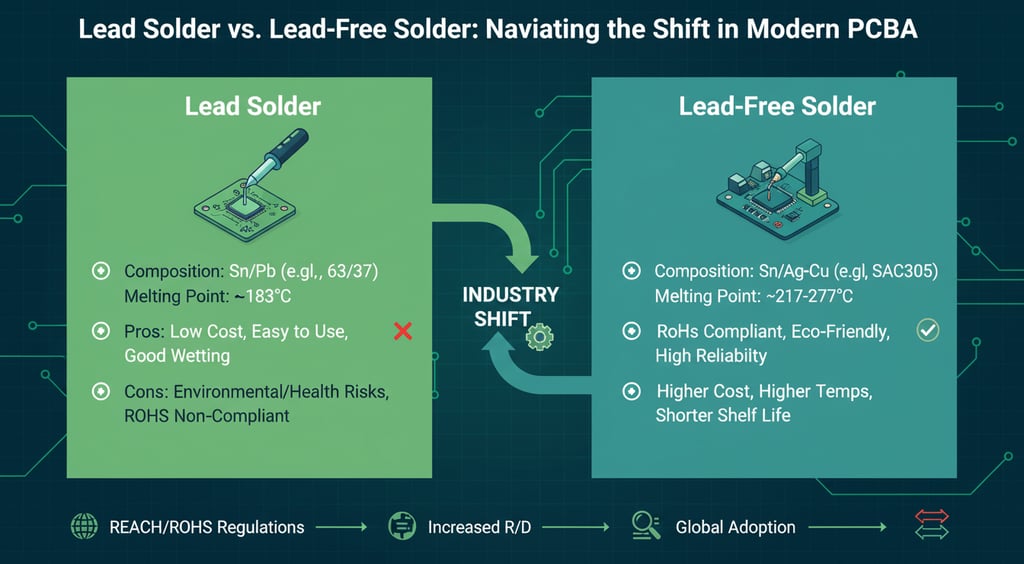
At OminiPCBA, we know that selecting the optimal soldering process is vital for product reliability, performance, and global compliance. This guide breaks down the technical differences between leaded and lead-free alloys and explains why lead-free solutions now lead the electronics manufacturing industry.
What is Solder?
Solder is a metal alloy engineered to create a permanent mechanical and electrical bond between electronic components and PCB copper pads. To ensure a secure connection without damaging the board, the solder must have a lower melting point than the metals it joins.
During the SMT (Surface Mount Technology) or DIP assembly process, heat is applied to the joint, allowing the solder to flow. As it cools, it forms a robust interface. Modern solder is categorized by its chemical composition, core style (flux), and physical form (paste, wire, or bar).
Lead Solder vs. Lead-Free Solder: Technical Comparison
For hardware engineers and procurement managers, understanding the trade-offs between these two alloys is essential for successful PCBA prototyping and mass production.
Traditional Leaded Solder (SnPb)
Historically, SnPb (Tin-Lead) solder was the industry standard. Its dominance was due to several performance advantages:
Defined Eutectic Point: Lead solder melts at a specific, predictable temperature, ensuring consistent results in automated reflow ovens.
Lower Thermal Stress: With a lower melting point than lead-free alternatives, it reduces the risk of heat damage to sensitive ICs and substrates.
Excellent Wetting & Ductility: SnPb solder provides superior "wetting" properties, resulting in flexible joints that resist cracking under mechanical stress.
However, the high toxicity of lead poses severe health risks and environmental hazards, leading to its phase-out in most commercial applications.
Modern Lead-Free Solder (RoHS Compliant)
Lead-free solder is typically composed of tin, silver, and copper (SAC alloys), sometimes enriched with nickel or zinc. While it requires higher processing temperatures, lead-free technology has matured significantly. It is now the mandatory standard for consumer electronics and is increasingly adopted in high-reliability sectors like medical and industrial electronics.
5 Key Benefits of Lead-Free PCB Assembly
Switching to lead-free manufacturing is no longer just a trend—it is a strategic move to future-proof your hardware.
Strict Regulatory Compliance (RoHS)
To sell electronics in the EU, USA, or China, adhering to RoHS (Restriction of Hazardous Substances) is a legal requirement. Lead-free assembly ensures your product meets global trade standards.
Environmental Sustainability
As E-waste grows, using lead-free alloys prevents toxic heavy metals from leaching into soil and groundwater, making your brand more environmentally responsible.
Enhanced Mechanical Strength
Lead-free joints are generally "harder" than leaded ones. In specific PCB applications, this provides better resistance to mechanical wear and prevents issues like "fillet lifting" in through-hole components.
Improved Health & Safety
Removing lead protects everyone in the supply chain—from the assembly technicians on the factory floor to the end-users of your devices.
Optimized Manufacturing Efficiency
Modern EMS providers like OminiPCBA have fully optimized SMT lines for lead-free profiles. The "learning curve" of the past is gone; lead-free is now the most efficient and reliable path to market.
Your Partner for RoHS-Compliant PCBA
OminiPCBA specializes in high-reliability, RoHS-compliant manufacturing. We offer a comprehensive range of lead-free materials and surface finishes—including ENIG (Electroless Nickel Immersion Gold) and Lead-Free HASL—to ensure your boards are durable and compliant. Every shipment includes a RoHS Certificate of Compliance (CoC) for your quality records.
Related Articles
Contacts
Email: sales@ominipcba.com
Mobile: +86-185-7640-5228
Copyright © 2007-2026. Omini Electronics Limited. All rights reserved.
Head Office: +86-755-2357-1819
Services


Your China turnkey partner for electronics manufacturing. We bridge design to delivery by leveraging the Shenzhen electronics ecosystem for precision engineering and streamlined PCBA supply chain logistics.
Ready to Build?
Get a comprehensive quote within 24 hours.