Phone: +86-755-2357-1819 Mobile: +86-185-7640-5228 Email: sales@ominipcba.com whatsapp: +8618576405228

The Hardware Engineer’s Guide to Sourcing Quality PCB Components
Supply chains have stabilized since the massive disruptions of the past few years, but the fundamental challenges of electronic component sourcing remain. For hardware engineers and procurement managers, sourcing circuit board components is no longer just a purchasing task—it is a critical risk mitigation strategy.
PCB TECHNOLOGYPCB MANUFACTURINGPCB ASSEMBLY
OminiPCBA
3/10/20263 min read
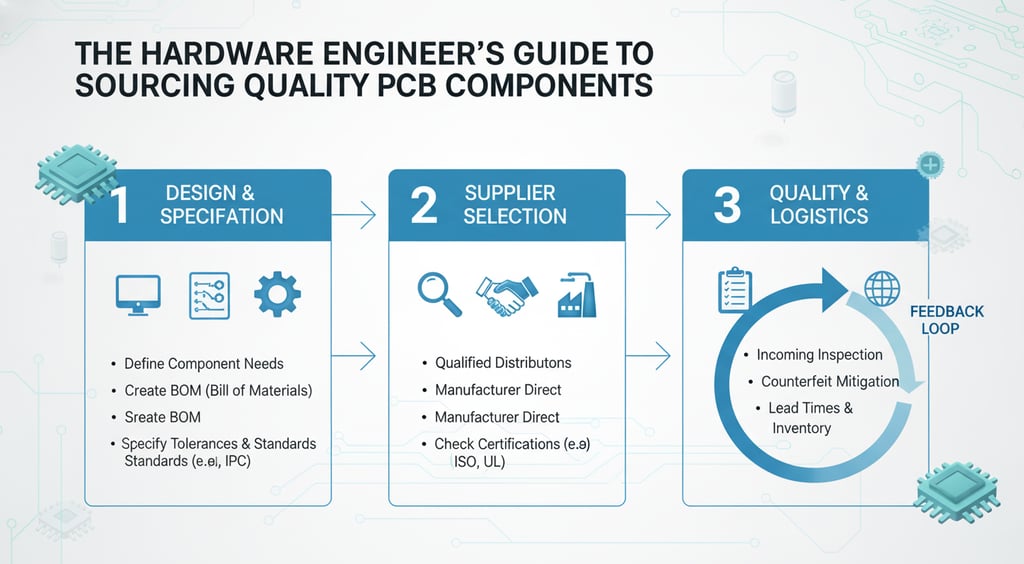
A single out-of-spec capacitor, a counterfeit microcontroller, or an abruptly discontinued power IC can derail an entire production run. As you transition from prototyping to low-to-medium volume production, the integrity of your Bill of Materials (BOM) dictates the ultimate reliability of your hardware.
This guide outlines practical, no-nonsense strategies for sourcing high-quality PCB components, avoiding costly supply chain pitfalls, and ensuring your next PCBA project scales seamlessly.
The Hidden Cost of "Cheap" Components
It is tempting to prioritize the lowest unit price, especially when margins are thin. however, the upfront savings of a few cents on a passive component or a dollar on an IC can evaporate instantly when failure occurs.
Substandard or counterfeit components trigger a cascade of manufacturing and engineering headaches:
Inflated Debugging Costs: Engineers spend weeks chasing "ghost" bugs, only to find the culprit is a noisy voltage regulator rather than a design flaw.
Manufacturing Yield Loss: Components with poor solderability or off-spec dimensions lead to tombstoning, cold joints, and high failure rates during SMT assembly.
Field Failures & Recalls: A part that passes initial bench tests but degrades under thermal stress in the field can irreparably damage your brand’s reputation.
To mitigate these risks, component procurement must be treated with the same technical rigor as the PCB layout itself.
1. Prioritize Authorized Distribution and Traceability
The golden rule of electronics sourcing is traceability. You need a documented chain of custody from the silicon foundry to the assembly line.
Franchised Channels: Whenever possible, source critical ICs and passives from authorized distributors (e.g., Digi-Key, Mouser, Arrow, Avnet) or directly from the manufacturer. This guarantees parts are factory-fresh, 100% genuine, and stored according to MSL (Moisture Sensitivity Level) standards.
Managing the Gray Market: If shortages force you to use independent brokers, insist on rigorous inspection. This should include X-ray analysis, decapsulation, and solderability testing performed to AS6081 standards.
2. "Bulletproof" Your Bill of Materials (BOM)
A vague BOM is a primary cause of purchasing errors. A production-ready BOM must leave zero room for interpretation. For every line item, ensure you include:
Complete Manufacturer Part Number (MPN): Include exact suffixes that specify packaging (tape and reel vs. tube) and temperature grades.
Manufacturer Name: Essential for verifying authorized sources.
Technical Parameters: Value, tolerance, voltage rating, and dielectric type (e.g., X7R vs. Y5V for MLCCs).
Designators: Clear reference designators (R1, C4, U2) that match your silkscreen and pick-and-place files.
Partnering with an EMS provider like OminiPCBA is significantly faster when your BOM is meticulously formatted, eliminating the back-and-forth required to clarify ambiguous parts.
3. Early Lifecycle Management
Nothing stalls a product launch faster than discovering a core IC is End of Life (EOL) during a 5,000-unit production run. During the schematic phase, monitor the status of every active component:
NRND (Not Recommended for New Design): Production is winding down; lead times will stretch, and prices will rise.
Obsolete/EOL: Production has ceased; avoid these at all costs.
Build a habit of reviewing Product Change Notifications (PCNs) and utilize lifecycle management tools to ensure your design remains manufacturable for years to reach.
4. Design for Sourcing (Cross-Referencing)
A rigid BOM is a fragile BOM. Smart sourcing begins in your ECAD software. By pre-approving alternates, you insulate your project against stockouts.
Passive Interchangeability: Most standard resistors and capacitors from Tier-1 brands (Yageo, Murata, Samsung) are interchangeable. List these approved alternates directly in your BOM.
Dual Footprints: For high-risk or volatile ICs, consider laying out dual footprints. The extra routing time is a small price to pay compared to a stalled production schedule if your primary chip becomes unavailable.
5. Leverage a Turnkey PCBA Partner
Managing dozens of purchase orders and tracking international shipments is a massive drain on resources. A turnkey PCBA manufacturer provides a strategic supply chain advantage:
The Shenzhen Advantage: Located in the heart of the global electronics hub, OminiPCBA offers direct access to authorized global distributors and vetted local manufacturers for connectors, bare PCBs, and passives.
Incoming Quality Control (IQC): We don't just receive parts; we verify them. Our IQC process checks MPNs, date codes, and physical integrity before components ever reach the SMT line.
BOM Scrubbing & DFM: Before procurement begins, our engineering team flags long lead times or obsolete parts, providing viable alternatives to keep your project on track.
The Bottom Line
Quality circuit board assembly is impossible without quality components. By utilizing authorized channels, maintaining detailed documentation, and partnering with an expert EMS provider, you can navigate the complexities of the global supply chain with confidence.
Ready to move from prototype to production? Upload your Gerbers and BOM to OminiPCBA, and let our procurement experts handle the heavy lifting.
Related Articles
Contacts
Email: sales@ominipcba.com
Mobile: +86-185-7640-5228
Copyright © 2007-2026. Omini Electronics Limited. All rights reserved.
Head Office: +86-755-2357-1819
Services


Your China turnkey partner for electronics manufacturing. We bridge design to delivery by leveraging the Shenzhen electronics ecosystem for precision engineering and streamlined PCBA supply chain logistics.
Ready to Build?
Get a comprehensive quote within 24 hours.