Phone: +86-755-2357-1819 Mobile: +86-185-7640-5228 Email: sales@ominipcba.com whatsapp: +8618576405228

Wearable Medical Electronics: Engineering Reliability in Flex
Overcoming dynamic failure and miniaturization limits in medical wearables. A technical guide to flexible PCB fabrication, rigid-flex assembly, and biocompatible integration.
PCB TECHNOLOGYPCB MANUFACTURINGPCB ASSEMBLY
OminiPCBA
1/4/20267 min read
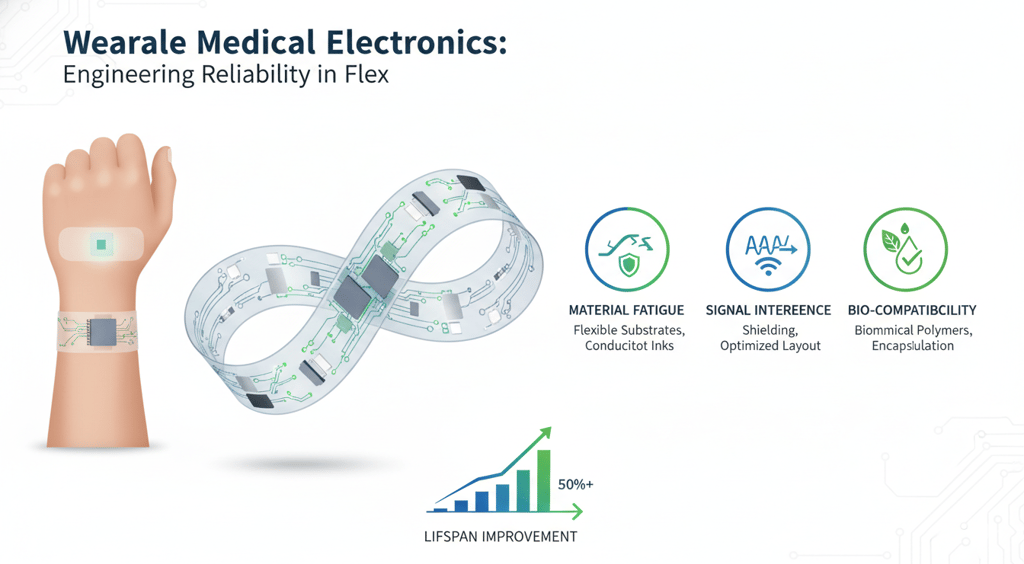
A quiet change moves through how health tools look today. Out of the big rolling machines in clinics come slim stickers for skin, bands that wrap around wrists. These tiny things now do what only large gear handled before. Such small size brings hard problems for connections inside them. Skin bends, shifts, sweats - machines hate those conditions. Wires and chips fight moisture, flexing, never staying still. Building links that last means shaping circuits like fabric, not metal. Bending without breaking becomes the rule, not luck.
Shrinking electronics for wearables isn’t just about size. Every time someone moves, the circuit inside a glucose sensor or heart patch bends, sometimes folds. These small shifts add up fast, stressing tiny parts in ways bigger gadgets never face. Think of walking - each step sends subtle forces through the device. Manufacturers can’t rely on old methods when building these. Materials must survive constant motion without failing. Connections between components need to stay firm even under repeated strain. What works in a desktop setup may crack here. Resilience becomes more critical than speed or cost. The body's rhythm turns hardware into something alive, almost. Tiny circuits live by how well they handle pressure, twist, stretch. Longevity hides not in power but in flexibility. Survival lies where most wouldn't look - at the quiet bend of a thin board.
The Material Matrix Beyond Standard Polyimide
Starting things off, a flexible circuit always leans on its dielectric base. Though most gadgets you carry use regular Polyimide, that material sometimes falls short when it comes to medical gear. What matters more there? How well it resists water soak and keeps electrical behavior steady.
Adhesive-less vs. Adhesive-based Laminates
Thin electronics made for skin-close use tend to skip glue layers when attaching copper to plastic film. Instead of acrylic or epoxy pastes common in budget gadgets, these rely on direct bonds. Without sticky middle parts, the whole stack gets narrower - important when hiding tech beneath fabric matters. Heat moves better too since nothing blocks the flow between materials. Laminates held together without adhesives now lead where slimness defines function.
Besides that, designs without glue hold their shape better under heat. When things get hot during SMT reflow, differences in how much the sticky layer and polyimide stretch tend to twist the board. If tiny 0201 parts and CSPs are crammed close, just a hint of bending might shift pads out of place.
Liquid Crystal Polymer LCP
When it comes to future wearables sending large amounts of data - like live neural signal streams - LCP stands out against Polyimide. Its ability to handle radio frequencies beats PI thanks to much lower signal loss during Bluetooth LE or 5G transfer. Unlike Polyimide, which soaks up noticeable water, LCP barely takes in any at all - less than 0.04%. Because sweat exposure matters greatly for skin-touching gadgets, this near-repulsion to moisture gives LCP an edge. Devices stuck to bodies benefit quietly from staying dry inside. What sets LCP apart isn’t just speed - it’s how little humidity changes its behavior.
Structural Design Meets Flexible Circuits
Foldable circuits bend just right around shapes, yet struggle to hold weighty parts such as power cells or tightly packed sensor arrays. To fix this, makers combine stiff FR4 sections with pliable polyimide zones - giving both strength and movement where needed. Instead of one material doing it all, layers work together: solid bases anchor hardware while thin films stretch through tight spaces.
Where the stiff part meets the bendable strip, things get tricky. That spot takes more strain than anywhere else. A wire running straight across splits open over time. It sticks out like a handle, pulling apart each time it bends. Building one that lasts means paying close attention right there.
Teardrops and Anchors
Strong designs need teardrop shapes where rings meet lines, helping spread out physical pressure. Because flexibility matters, the outer insulating layer pushes just into the solid part, holding things steady under pull. When accuracy counts, some makers use partial cuts in the covering or add small supports right where needed so bends stay wider than ten times the material's depth.
Bookbinder Construction
When bending a flexible circuit with many layers, the inside curve gets squished while the outside stretches. To fix this, makers use something called the Bookbinder method. Layers are cut at slightly different lengths before stacking, similar to how paper edges fan out in a hardcover notebook. This setup lets each layer handle stress more equally. Instead of crumpling under strain, they stretch smoothly along curved surfaces. The result stays stable even when wrapped tightly around arms or legs.
The Assembly Challenge SMT Amid Constant Change
Fabricating the bare board gets you partway there. Getting parts onto a bendable surface? That demands tackling quirks few expect. What trips most people up isn’t heat or alignment - it’s flatness that slips away.
Wiggling under pressure, flexible circuits refuse to stay put like stiff FR4 boards do. When the surface tilts even slightly during printing, alignment slips. The stencil fails to meet the copper pad tightly. Paste squirts where it should not go. Too much ends up between joints - sometimes too little lands on pads. Solder bridges appear without warning.
Advanced Fixturing and Pallets
Most tape-based solutions fail when handling large-scale medical manufacturing demands. Instead, what sets the standard now is relying on magnetic setups or vacuum systems built from man-made stone materials like Durostone, keeping flexible circuits stretched tight through printing, placement, and heating stages. Heat absorption matters - the bulkiness of these support trays affects temperature flow; should they soak up excessive warmth, the board sees a lower-than-needed heat curve, resulting in weak solder connections that seem fine at first yet trigger sporadic malfunctions later on.
Low Temperature Solders Compared With SAC305
Though SAC305 solder remains common for lead-free connections, certain medical wearables include parts - such as delicate biosensors or plastic lenses - that fail under high heat during assembly. Because of that, peak temperatures above 240°C can damage them. So instead, makers sometimes switch to tin-bismuth-silver blends or sticky conductive glues that set at cooler levels. These options help avoid melting sensitive bits. Yet they usually resist pulling forces less than standard solders do. Strength drops when temperature does. Each design faces a balance: protecting fragile components or standing up to physical knocks. Testing each version by simulating real-world falls becomes essential to prove it holds up.
Miniaturization and Underfill
Hidden from sight - that’s what people want when it comes to wearable gadgets, pushing parts smaller than ever before. Tiny 01005 resistors pop up often now, tucked inside devices like pulse trackers and earpieces. WLCSP chips show up just as much, squeezed into tight spots where space vanishes fast.
What makes this tricky is how thin the connections are between solder points. Tiny spheres hold a 0.3mm pitch BGA together - barely visible. Bend the part even slightly, then those minuscule links take on heavy strain.
Because of this, applying Underfill becomes required. Flowing into place by drawing itself through tiny spaces, the epoxy sticks the chip directly onto the surface below. Stress then spreads out over the full unit instead of pressing only on the solder connections. That stiffness though forms one firm area right where it's applied. A stiff section right by a bend zone adds concentrated strain. Where the board folds least, seasoned designers set those firm parts - floating them apart from main curve lines.
The Human Interface Biocompatibility and Protection
Worn while sleeping, exercised in, even doused in showers - this isn’t some sealed gadget locked away. Sweat mixes with skin oil, soap cuts through, creating a blend that attacks materials slowly.
Conformal Coating vs. Potting
Salt mist can get through regular acrylic coatings pretty easily. Not holding back now, low-pressure molding stands out for dependable wearables. Hot-melt polyamides wrap circuits gently, almost like skin. Water stays out - meets IP67 and IP68 rules without trying hard. Feels safe on the body too, checked against ISO 10993 standards. Shape shifts during cooling, yet keeps everything sealed tight.
Starting off differently, thin films made by plasma methods step in where weight and space matter most. Every face gets covered - yes, even under parts - by a waterproof skin just atoms high, keeping moisture away while letting heat pass through.
Skin Sensitivity
Skin contact parts need safe materials. Not every metal works well here. Hard gold on top of palladium helps block irritation. Sweat can cause tiny electric reactions that eat away at some metals. A protective coating made through vapor methods adds strong defense. Nickel in circuit finishes sometimes causes rashes. So it gets replaced where skin meets device. Protection comes from layers built one on another. These choices keep users comfortable during daily use.
Dynamic Reliability Through Rigorous Testing
A single glitch inside a hospital gadget might mix up symptoms or erase vital health records. Because of that, checking bendable circuits means pushing past basic power flow checks.
The MIT Folding Test
A small sample from each batch gets tested to check how well the copper lines hold up. Clamped in place, it bends back and forth - usually to about 135 degrees - at a steady pace. Resistance rising marks the endpoint of the test. When used where movement happens often, like in a jointed medical support, surviving one hundred thousand folds becomes the target.
Grain Direction Matters
Hitting this number of bends means watching how the copper's grains line up. Rolled Annealed copper holds up better because its grains run flat, stretching out when bent instead of breaking. Unlike that, Electro-Deposited copper builds up vertically, which tends to split under movement. Companies such as Omnipcba position each board on the production sheet so the fold goes across the grain, not along it - this way, it lasts much longer through repeated stress.
Power and Safety in Battery Design
Worn devices struggle with power more than most people realize. Inside them, the energy pack usually takes up the biggest chunk of space. Sometimes it even weighs down the whole thing the most. Shaping batteries differently has led to rounded designs using lithium-polymer chemistry. Another path moves toward stiff yet slightly bendable units built on solid electrolytes.
Hooking up these power supplies needs care. Because heat can spread, melting metal onto battery ends might cause trouble. Instead, joining parts with quick welds works better - so do tiny plugs that lock in place, made by companies such as JST or Molex. On top of that, the system watching the battery has to live inside the bendable board itself. That board? It runs extra checks just in case things get too hot - a real danger if the gadget wraps around someone’s arm.
Conclusion
Wearable medical tech begins life at the meeting point of smart materials, clever mechanics, and ultra-fine construction. Tiny mistakes here - smaller than a speck of dust - can ripple into serious harm for those who rely on these tools.
Getting things right here means seeing the whole picture. Just drawing a circuit isn’t sufficient - grasping how polyimide stretches and flows matters, along with how solder paste moves during printing, plus what sweat and salt do inside the body. Success depends on working with someone who can build layered rigid-flex boards without error, placing tiny parts exactly where they belong, every single time. With biological systems now merging into machines, printed circuits stop being just hardware - they act more like lab-grown membranes, pliable yet tough, forming an electronic web that keeps medical tech alive.
Related Articles
Contacts
Email: sales@ominipcba.com
Mobile: +86-185-7640-5228
Copyright © 2007-2026. Omini Electronics Limited. All rights reserved.
Head Office: +86-755-2357-1819
Services


Your China turnkey partner for electronics manufacturing. We bridge design to delivery by leveraging the Shenzhen electronics ecosystem for precision engineering and streamlined PCBA supply chain logistics.
Ready to Build?
Get a comprehensive quote within 24 hours.